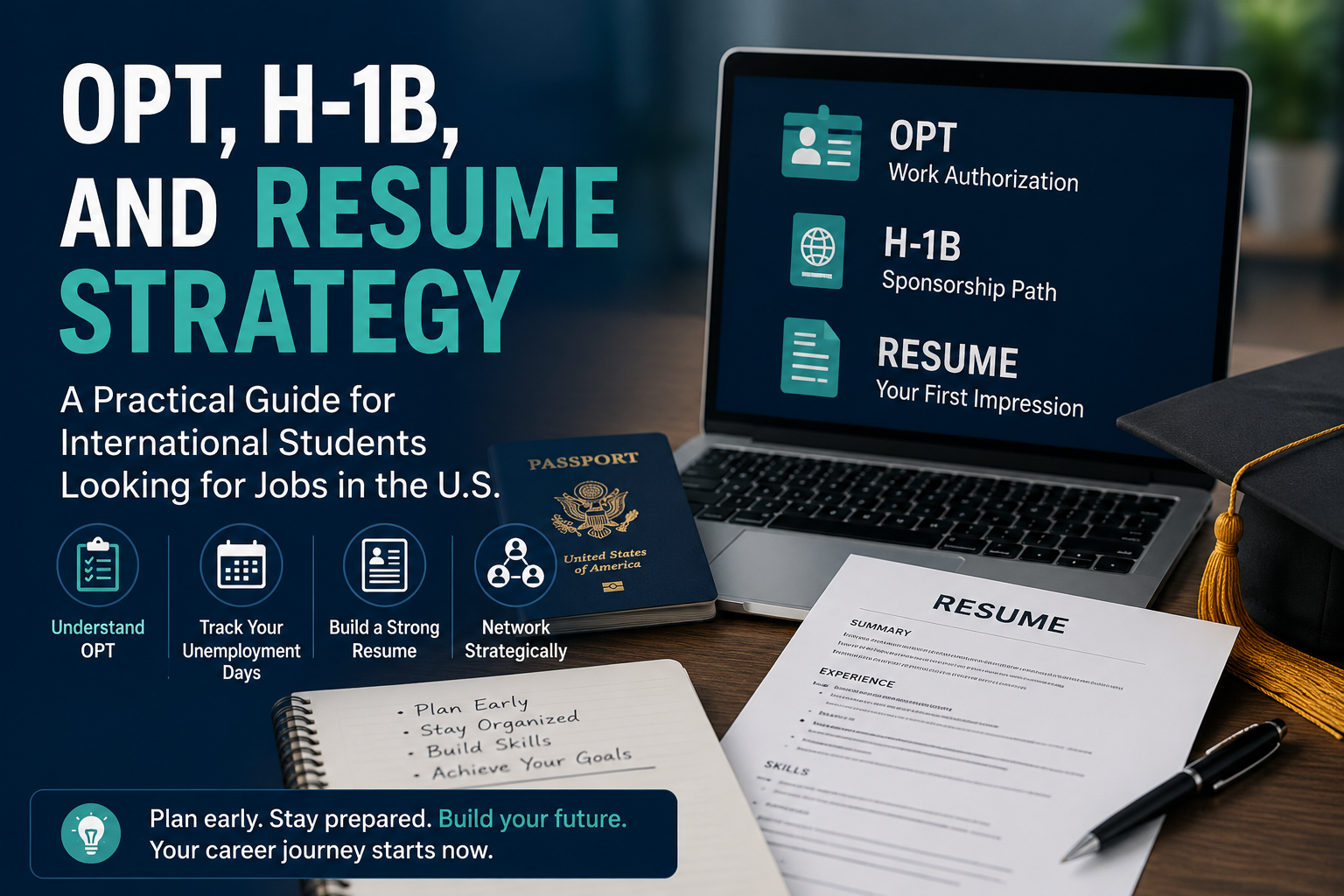
OPT, H-1B, and Resume Strategy: A Practical Guide for International Students Looking for Jobs in the U.S.
A practical guide for international students who want to prepare early for OPT, improve their resume, and approach the U.S. job market with a stronger career strategy.
OPT, H-1B, and Resume Strategy: A Practical Guide for International Students Looking for Jobs in the U.S.
Searching for a job in the U.S. can be a real challenge for international students. It's not simply about finding an open position. You also need to grasp the right timing, sort out complex documents, understand what employers expect, and clearly show off your skills.
That is why career strategy matters.
You may have strong technical skills, academic experience, and project work, but without a clear plan, it becomes easy to feel confused or discouraged. The goal is not only to apply for jobs. The goal is to apply with direction.
## 1. Understand OPT Early
Optional Practical Training, commonly known as OPT, allows eligible F-1 students to work in a field related to their major. USCIS states that eligible F-1 students may apply for up to 12 months of OPT employment authorization, either before or after completing their academic studies.
This means students should not wait until graduation before thinking about their career path. You should start preparing your resume, portfolio, LinkedIn profile, and job search strategy months before you need employment.
For students in STEM fields, there may also be a 24-month STEM OPT extension if they meet the requirements. USCIS explains that certain F-1 students with STEM degrees may apply for this extension.
2. Track Your Unemployment Days
One of the biggest mistakes students make is ignoring the unemployment rules. According to Study in the States, post-completion OPT has a 90-day unemployment limit, while STEM OPT allows a total of 150 days, including unemployment days used during regular post-completion OPT.
This is why students should not treat the job search casually. Every week matters. You need a system for applications, follow-ups, networking, interviews, and documentation.
3. Build a Resume That Matches the U.S. Job Market
A strong resume is not just a list of duties. It should show results, tools, projects, and impact.
Instead of writing:
Worked on data analysis project.
Write something stronger:
Analyzed traffic crash data using Python, Pandas, and visualization tools to identify high-risk ZIP codes and support road safety recommendations.
The second version is better because it shows what you did, what tools you used, and why the work mattered.
Your resume should include:
Technical skills: Python, SQL, Excel, Power BI, Tableau, machine learning, cloud tools, or any tools relevant to your field.
Projects: Academic projects, personal projects, capstone work, research, dashboards, websites, automation systems, or data analysis work.
Impact: Numbers, outcomes, improvements, insights, or business value.
Keywords: Words from the job description, especially tools, responsibilities, and required skills.
4. Do Not Wait for Sponsorship Conversations Too Late
Many international students fear the H-1B conversation. That fear is understandable, but silence can create confusion.
You do not need to start every conversation with sponsorship. First, prove your value. Show your skills. Show that you understand the role. Then, when the process becomes serious, be clear and professional about your work authorization situation.
Employers respect clarity. What they do not like is confusion late in the hiring process.
5. Apply Strategically, Not Randomly
Submitting hundreds of applications without a plan can lead to frustration. A better strategy is to group your applications.
For example:
Group 1: Jobs that strongly match your skills
Group 2: Jobs where you meet most requirements
Group 3: Stretch roles where you need networking or referrals
You should also track every application in a simple spreadsheet with columns like:
Company, Job Title, Date Applied, Contact Person, Status, Follow-up Date, Interview Stage, Notes.
This helps you stay organized and professional.
6. Projects Can Make You Stand Out
For students and entry-level applicants, projects are powerful. A good project can show employers what you can do even before you have years of experience.
Examples include:
A data dashboard, machine learning model, automation workflow, website, business analysis report, research project, or case study.
The key is to explain the problem, your process, tools used, and final result.
7. Networking Is Not Begging
Many students misunderstand networking. Networking is not asking strangers for jobs. It is building professional relationships.
You can message alumni, recruiters, professionals, classmates, professors, and people in your target industry. Keep your message short, respectful, and specific.
For example:
Hello, I am currently exploring opportunities in data analytics and noticed your experience in this field. I would appreciate any advice you may have for someone preparing for OPT and entry-level roles.
That type of message is simple, professional, and not desperate.
Final Thoughts
International students need more than a resume. They need a strategy.
Start early. Understand your OPT timeline. Build strong projects. Improve your resume. Track your applications. Network professionally. Learn how to explain your value clearly.
The U.S. job market is competitive, but preparation gives you an advantage.
Your goal is not just to get any job. Your goal is to build a career path with clarity, confidence, and direction.
Get past the ATS on your next application
JobOS Resume Studio tailors your resume to any job description and scores it against the ATS before you hit apply.
Essential Tools to Land Your Next Job
AI Resume Studio
Tailor your resume to any job in 60 seconds
Interview Prep Kit
AI-generated, company-specific prep guides
One-Click Autofill
Chrome extension fills apps on 37 ATS platforms
H1B Sponsor Detection
See sponsorship history on every job
Trusted by job seekers beating the ATS in 2026
Free to start · No credit card